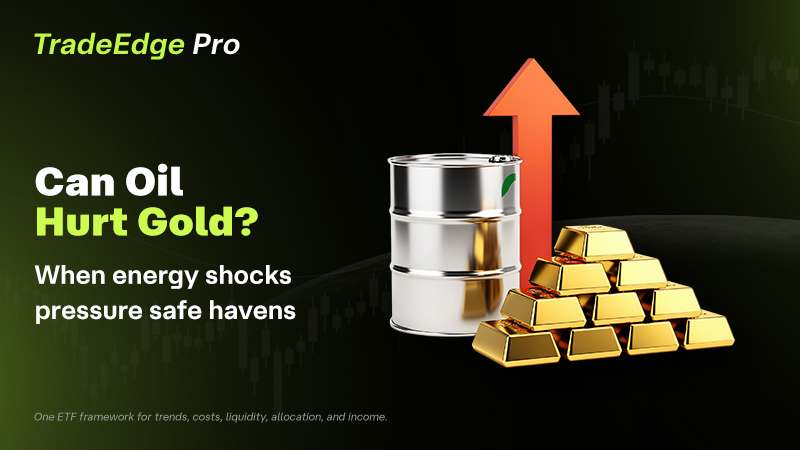
Yes, a conflict-driven surge in oil prices can indeed hurt gold, particularly in the immediate aftermath. This counter-intuitive market reaction occurs when traders prioritise the secondary effects of an energy shock over gold’s traditional safe-haven status.
Specifically, if the market interprets higher oil prices as a catalyst for renewed inflation, it will anticipate a more aggressive stance from central banks. This leads to higher bond yields and a stronger US dollar, both of which create significant headwinds for the non-yielding, dollar-denominated precious metal. Understanding this mechanism is crucial for traders navigating the complexities of geopolitical events in 2026.
The question of whether can oil prices hurt gold during conflict is not straightforward; it depends entirely on the market’s prevailing narrative. If the focus is on systemic financial risk and a flight to safety, both assets may rise.
However, if the dominant concern becomes inflation and the policy response it necessitates, gold can initially underperform or fall, even as geopolitical tensions escalate. This article will dissect the key market dynamics at play, providing a framework for analysing this critical relationship.
Table of Contents
The Short Answer: Yes, Oil Can Hurt Gold First
An abrupt spike in oil prices caused by a supply shock from a conflict can trigger a cascade of bearish factors for gold before its safe-haven qualities take over. The initial market reaction often centres on the macroeconomic consequences. Unlike a gradual rise in oil prices driven by healthy economic demand, a supply shock acts as a tax on the global economy, simultaneously stoking inflation and threatening growth.
In this scenario, financial markets immediately begin to re-price the trajectory of monetary policy. The fear is not just inflation itself, but that central banks will be forced to keep interest rates higher for longer to combat it, thereby strengthening the appeal of yield-bearing assets over gold. This is the primary reason the answer to ‘can oil prices hurt gold during conflict?’ is often a surprising ‘yes’ in the short term.
Why Higher Oil Prices Can Be Bearish for Gold
The negative correlation stems from a chain of four interconnected market responses. A conflict that threatens oil supply routes or production facilities ignites fears of persistent inflation. This, in turn, alters expectations for central bank policy, driving up government bond yields and strengthening the US dollar. Each of these steps creates a more challenging environment for gold prices.
Oil Raises Inflation Fears
A sudden surge in energy costs feeds directly into headline inflation metrics through higher transportation and manufacturing expenses. Market participants, seeing oil as a key input for the global economy, will quickly price in a future of higher consumer and producer price indices. This isn’t just about the immediate price shock; it’s about the risk that inflation expectations become ‘un-anchored’, forcing a more protracted policy response.
This is the first link in the chain explaining how oil prices can hurt gold during conflict by shifting the market’s focus from geopolitical risk to inflation risk.
Inflation Fears Delay Rate Cuts
Central banks are mandated to maintain price stability, making them highly sensitive to inflationary shocks. When an oil price spike occurs, the probability of interest rate cuts diminishes rapidly, and the market may even begin to price in the possibility of further hikes. In early 2026, for example, with major central banks poised to begin an easing cycle, a conflict-driven oil surge above $100 per barrel could postpone those plans indefinitely.
This hawkish pivot, or the delay of a dovish one, is a significant negative for gold, which thrives in a low-interest-rate environment.
Higher Yields Hurt Non-Yielding Gold
This is perhaps the most direct transmission mechanism. Gold offers no yield or coupon payment. Its value is derived from its scarcity and its role as a store of value. When the yield on ‘risk-free’ assets like 10-year government bonds rises, the opportunity cost of holding gold increases. Investors can earn a more attractive return by simply holding bonds. Data consistently shows a strong inverse correlation between gold prices and real yields (nominal yields minus inflation expectations).
As an oil shock pushes nominal yields on instruments like the US 10-Year Treasury note higher, gold becomes mathematically less attractive to hold, leading to selling pressure. This dynamic is a clear example of how oil prices can hurt gold during conflict.
A Stronger Dollar Amplifies the Pressure
During periods of global uncertainty, capital often flows into the US dollar, which is viewed as the world’s ultimate safe-haven asset and primary reserve currency. Higher US bond yields further enhance the dollar’s appeal. Since gold is priced internationally in US dollars, a stronger dollar (as measured by the DXY index) makes gold more expensive for buyers using other currencies.
This currency effect can suppress demand and weigh on the price. In this scenario, the dollar and gold are competing for safe-haven flows, and if the market is focused on yields and relative economic strength, the dollar often wins in the initial phase of a crisis.
Conflict-Driven Oil Spikes vs. Normal Commodity Strength
It is essential to distinguish why a war-driven oil rally has a different impact than a demand-driven one. The source of the price increase fundamentally alters its interpretation by the market and, consequently, its effect on gold.
Supply Shock Is Not the Same as Broad Commodity Reflation
A demand-led rise in commodity prices, including oil, is typically a sign of a robust, growing global economy. This is often part of a ‘reflation’ trade where investors expect broad-based price increases and asset appreciation.
In such an environment, gold can perform well as an inflation hedge alongside other commodities. However, a conflict-induced supply shock is an economically destructive event. It has a stagflationary character, meaning it brings higher inflation and lower economic growth.
The market rightly views this as a net negative for the economy, which reinforces the focus on central bank policy and potential for policy error, rather than on simple inflation hedging.
War-Driven Oil Rallies Change Central-Bank Expectations
The psychological impact of a conflict-driven price spike forces market participants to game out worst-case scenarios for both supply disruption and the resulting policy response.
The primary concern becomes the difficult trade-off facing central bankers: do they fight inflation by keeping rates high, risking a deeper recession, or do they support growth and risk letting inflation spiral? This uncertainty often leads to increased volatility and a preference for cash-like instruments and the US dollar, at least initially.
This is another reason the query ‘can oil prices hurt gold during conflict’ leads to a complex, nuanced answer rooted in market psychology.
When Oil Starts Helping Gold Instead
The negative relationship is not permanent. There is a tipping point where the narrative shifts, and the very factors that initially hurt gold can begin to support it. This transition often occurs once the secondary effects of the oil shock become more pronounced.
If Growth Weakens and Yields Roll Over
If persistently high oil prices begin to cause significant economic damage—evidenced by falling PMIs, rising unemployment, and lower corporate earnings—the market’s focus will shift from inflation to recession. At this point, expectations for central bank policy will invert. Traders will start pricing in eventual rate cuts to support the economy. This will cause bond yields to fall, drastically reducing the opportunity cost of holding gold and making it a more attractive safe-haven asset.
If Inflation Becomes a Purchasing-Power Story
Initially, inflation is a ‘rate story’. Later, if it proves persistent and erodes the real value of savings and investments, it becomes a ‘purchasing power story’. When investors lose faith in the ability of central banks to control inflation without crashing the economy, they seek out real assets that cannot be devalued by monetary policy. This is gold’s historical role as a long-term store of value. When the narrative shifts from ‘inflation means higher rates’ to ‘inflation is destroying my wealth’, capital flows back into gold.
If the Dollar Stops Absorbing the Safe-Haven Bid
The US dollar’s safe-haven status is not absolute. If the economic fallout from an energy crisis hits the US particularly hard, or if the conflict raises questions about the US’s fiscal position, the dollar may cease to be the sole beneficiary of safe-haven flows. In such a scenario, gold’s appeal as a neutral, non-sovereign store of value increases, and it may begin to rally even if the dollar remains firm or weakens only slightly.
A Trader’s Checklist: 4 Signals Oil Is Stopping Gold From Rallying
For traders seeking to apply this analysis, here are four key real-time indicators that suggest an oil price spike is currently hurting, rather than helping, gold. Monitoring these data points can provide a clear view on the question: can oil prices hurt gold during conflict right now?
| Signal | What to Watch | Indication for Gold |
| 1. Oil Price Velocity | A rapid, sharp increase in Brent or WTI crude prices (e.g., >10% in a few sessions) following a geopolitical event. | Bearish. This signals a supply shock, immediately triggering inflation and rate-hike fears. |
| 2. Rising Bond Yields | A concurrent rise in the US 10-Year Treasury Yield. Watch for key psychological levels like 4.5% or 5%. | Bearish. This directly increases the opportunity cost of holding non-yielding gold. |
| 3. Stronger US Dollar | The US Dollar Index (DXY) rallying above recent resistance levels (e.g., 106, 108). | Bearish. This indicates safe-haven flows are favouring the dollar over gold and creates a currency headwind. |
| 4. Gold ETF Flows | Data from major gold-backed ETFs (like GLD or IAU) showing net outflows or stagnant inflows. | Bearish. This is a direct measure of investor sentiment, showing that capital is moving out of gold positions. |