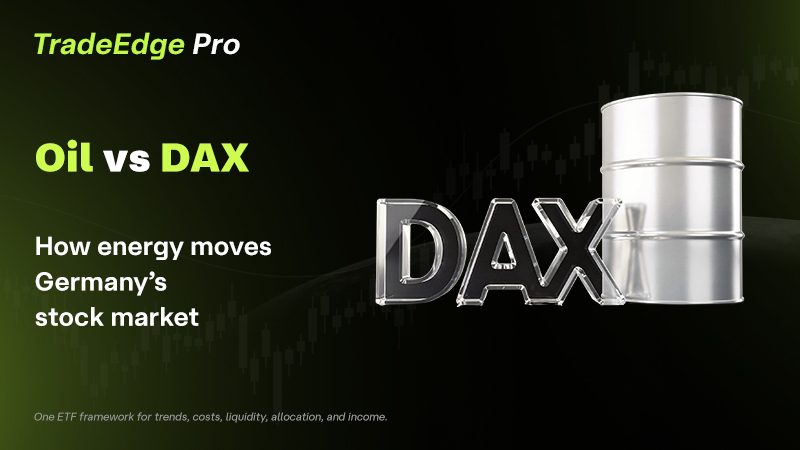
Oil prices affect the DAX through four primary channels: direct corporate cost pressures, shifting inflation expectations, subsequent interest-rate repricing, and broad changes in investor risk sentiment.
While the relationship is not perfectly linear, large energy shocks typically have a pronounced negative impact on Germany’s leading stock market index. This is because the DAX is heavily weighted towards cyclical, industrial, and export-driven companies that are acutely sensitive to energy input costs and global economic health. Understanding how oil prices affect the DAX is therefore crucial for anyone trading or investing in European equities.
Minor fluctuations in crude oil may have a limited day-to-day impact, but significant, shock-driven movements—whether from supply disruptions or geopolitical events—can trigger substantial volatility. This guide provides a detailed analysis of the mechanisms at play, the sectors most at risk, and what traders should monitor in 2026.
Table of Contents
Why Do Oil Prices Matter So Much for the DAX?
The index’s unique composition makes it exceptionally responsive to energy market dynamics. Unlike technology-heavy indices, the DAX is a barometer for Germany’s industrial prowess, which is intrinsically linked to energy consumption and global trade cycles. Representing approximately 80% of the free-float market capitalisation of companies listed in Frankfurt, its performance is a direct reflection of the health of the nation’s core economic sectors.
The DAX is Highly Exposed to Cyclical and Industrial Companies
A significant portion of the DAX index is composed of businesses from the automotive, chemical, and industrial manufacturing sectors. These industries are characterised by high energy consumption and long supply chains. Consequently, their operational costs and profit margins are directly and immediately impacted by swings in oil and gas prices.
When energy prices surge, these companies face a margin squeeze unless they can pass the higher costs onto consumers, which is often difficult in a competitive global market.
Energy Costs Feed Directly into Profit-Margin Expectations
Analysts and investors closely model corporate earnings based on input costs. An unexpected spike in Brent or WTI crude prices forces an immediate downward revision of profit forecasts for energy-intensive firms. This repricing of future earnings is a fundamental reason how oil prices affect the DAX so swiftly. The stock market, being a forward-looking mechanism, sells off in anticipation of weaker financial results long before they are officially reported.
Oil Also Changes the Inflation and Rate Outlook for Europe
Rising energy prices are a primary driver of headline inflation across the Eurozone. This puts pressure on the European Central Bank (ECB) to maintain a more hawkish monetary policy stance. For instance, the ECB’s projections for 2026 indicate an inflation rate of 2.6%, up from 2.1% in 2025, with energy prices cited as a significant contributing factor.
The prospect of higher interest rates for longer typically weighs on equity valuations, as it increases the discount rate for future cash flows and raises borrowing costs for corporations.
The Four Ways Oil Prices Affect the DAX
The transmission of oil price shocks into the German stock market can be broken down into four interconnected mechanisms. Each plays a role in explaining how oil prices affect the DAX.
1. Higher Oil Raises Corporate Cost Pressure
This is the most direct impact. Higher crude prices translate into increased expenses across the entire industrial value chain. This includes:
- Transportation Costs: Logistics, shipping, and aviation fuel costs rise, impacting every company that moves physical goods.
- Manufacturing Inputs: Energy is a primary cost in running factories and production lines, particularly for heavy industry.
- Chemical Feedstocks: The chemical sector uses oil derivatives (like naphtha) as essential raw materials. Higher oil prices directly squeeze their margins.
2. Higher Oil Lifts Inflation Expectations
When oil prices trend higher, the market anticipates a rise in the Consumer Price Index (CPI). This leads investors to become more cautious about the ECB’s potential policy response. Fears of more aggressive interest rate hikes to combat inflation can create a headwind for equities, as higher rates make safer assets like bonds relatively more attractive and can slow economic activity.
3. Higher Oil Increases Growth Fears
Sustained high energy prices act as a tax on consumers and businesses. This can dampen economic growth prospects by reducing real disposable income for households, which curtails spending on discretionary goods (like new cars).
For corporations, the combination of lower revenue expectations and higher costs can lead to reduced investment and hiring, feeding into a negative economic outlook that weighs on the stock market.
4. Oil Shocks Change Risk Sentiment Across European Equities
Geopolitically driven oil price spikes often coincide with a broader ‘risk-off’ move in global markets. Investors tend to sell assets perceived as higher risk, such as equities, and move into safe-haven assets. Because the DAX is dominated by cyclical companies whose fortunes are tied to the global economic cycle, it is often one of the first major indices to be sold off when risk appetite deteriorates. This dynamic is a key part of how oil prices affect the DAX during periods of market stress.
Which DAX Sectors Are Most Sensitive to Oil Prices?
The impact of oil price volatility is not uniform across the index. Certain sectors exhibit heightened sensitivity due to their business models.
| DAX Sector | Primary Impact | Quick Explanation |
|---|---|---|
| Autos | Costs + Demand | Higher oil prices raise production costs and can weaken consumer demand for vehicles. |
| Chemicals | Feedstock Costs | Chemical producers are directly exposed because oil-linked inputs can quickly pressure margins. |
| Industrials | Costs + Growth | Energy-intensive operations and weaker global growth both weigh on earnings. |
| Energy-Linked Names | Revenue Support | Some energy-related businesses may benefit from stronger oil and gas prices. |
Does Higher Oil Always Hurt the DAX?
No, the context of the price rise is critical. It is a mistake to assume a universally negative correlation. The reason behind the oil price increase determines its ultimate effect on the German stock market.
- Demand-Driven Rises: If oil prices are rising moderately due to strong global economic growth, it can be a net positive. Robust demand for German exports (cars, machinery) can outweigh the higher energy costs, supporting corporate profits and the DAX.
- Supply-Side Shocks: If prices spike suddenly due to a supply disruption (e.g., geopolitical conflict), the impact is almost always negative. This scenario brings higher costs without the benefit of stronger demand, leading to stagflationary fears that are particularly damaging for cyclical stocks.
What Happens to the DAX When Oil Falls?
Just as with rising prices, the reason for falling oil prices is paramount.
Lower Oil Can Improve Margins and Ease Inflation Fears
A gradual decline in oil prices due to increased supply or stabilized demand can be bullish for the DAX. It directly lowers input costs for industrial giants, boosts profit margins, reduces inflationary pressure (giving the ECB room to be less hawkish), and increases consumers’ real purchasing power. This is the ideal scenario for the German index.
But Falling Oil Caused by Growth Fears Sends a Different Message
Conversely, if oil prices are plummeting because traders are anticipating a sharp global economic downturn or recession, it is a bearish signal for the DAX. In this case, the negative implications of collapsing global demand for German exports far outweigh the benefits of lower energy costs. The index will likely fall alongside oil, as both are reflecting the same underlying economic pessimism.
What Recent 2026 Market Moves Tell Us
Recent market behaviour provides a clear case study. When news of a potential ceasefire in a major conflict zone emerged, oil prices reacted instantly. Brent crude dropped to $94.75 and WTI to $94.41. In response, the DAX staged a strong rally, as the market priced in both lower energy costs and reduced geopolitical risk.
However, when the fragility of the ceasefire became apparent, oil prices rebounded, and the DAX promptly gave back a portion of its gains. This illustrates the tight, real-time correlation during periods of high uncertainty. Despite these headline price swings, traders noted that physical crude premiums remained tight, suggesting the underlying supply-demand balance was still precarious.
This is set against a backdrop where the U.S. Energy Information Administration (EIA) forecasts Brent could peak around $115 per barrel in the second quarter of 2026, highlighting that upside risk has not disappeared.
What Investors Should Watch When Oil Moves
To effectively trade or invest based on how oil prices affect the DAX, market participants should monitor a basket of indicators:
- Brent/WTI Futures: The headline price and trend of the main crude benchmarks.
- Physical Crude Premiums: The difference between the physical price and the futures price can indicate real-world supply tightness.
- ECB Commentary: Pay close attention to how central bankers are interpreting energy’s impact on their inflation mandate.
- Sector Leadership in the DAX: Observe whether cyclical sectors (autos, chemicals) are underperforming or outperforming defensive ones.
- Geopolitical Headlines: Monitor news from key oil-producing regions that could signal potential supply disruptions.