

For any aspiring or seasoned UK investor, one of the most fundamental questions is surprisingly elusive: “what time does the foreign exchange market open?” Many beginners also ask about the forex market open time, wonder “what are the forex market sessions,” or question “forex market open on weekends.” The simple answer, “it’s open 24 hours a day,” is both true and misleading. The reality is a complex, fascinating global relay of capital, where understanding foreign exchange market open periods and session overlaps isn’t just important—it’s everything.
Understanding the intricate dance of the global forex sessions is the difference between catching a powerful market wave and being caught in a stagnant tide. Why does the market suddenly surge in the afternoon? Why do certain currency pairs move aggressively while you sleep? The answers lie in knowing not just that the market is open, but who is opening it.
This comprehensive 2025 guide is designed for UK traders. We’ll dismantle the 24-hour clock, pinpoint foreign exchange market open times, and reveal high-volatility windows that can define your trading success. Let’s move beyond basics and turn time into your most powerful trading asset.

🌏 Understanding the 24-Hour Forex Market Cycle
The foreign exchange market open 24 hours a day stems from its decentralised structure. Unlike a stock exchange, forex has no central physical location. It is an over-the-counter (OTC) market, a global network of banks, institutions, and individual traders. This network spans multiple time zones, ensuring when one major centre closes, another opens. For UK traders, knowing what time does the forex market open in each session is key to maximising opportunities.
Why is the Forex Market Open 24 Hours a Day?
Imagine a continuous financial baton pass around the globe. The trading week kicks off on Sunday evening (UK time) as financial centres in Sydney and Wellington begin their Monday morning. The baton is then passed to Tokyo, followed by Singapore and Hong Kong. As Asia winds down, Europe—led by Frankfurt and the titan, London—takes over. Finally, New York opens, and for a few crucial hours, the world’s two largest financial hubs are trading simultaneously, before the cycle returns to Sydney. This seamless transition ensures constant liquidity and the ability to trade currencies at almost any time, day or night, during the working week. For optimal execution, traders can leverage Ultima Markets MT5 to access global sessions in real time.
The Official Forex Trading Week: From Sunday Evening to Friday Night
For UK traders, what time does the forex market open? The trading week begins Sunday at approximately 10:00 PM GMT (11:00 PM BST) and ends Friday at 10:00 PM GMT/BST. While the market is technically open all week, liquidity and volatility vary depending on what are the forex market sessions active.
- Weekly Open: Sunday, 10:00 PM GMT
- Weekly Close: Friday, 10:00 PM GMT
Remember to account for British Summer Time (BST), which runs from the last Sunday in March to the last Sunday in October. During this period, the UK is one hour ahead of GMT (GMT+1).
⏰ The Four Major Forex Trading Sessions: A Global Relay Race
To truly master forex timing, you need to think in terms of four key trading sessions. Each session is named after the major financial city that anchors it. Understanding their individual characteristics and, more importantly, their overlaps, is paramount for knowing what are the forex market sessions.
The Sydney Session: The Quiet Start to the Week
As the first major market to open, the Sydney session sets the tone for the week. It’s typically the quietest of the four sessions. However, significant economic data releases from Australia (AUD) and New Zealand (NZD) can cause sharp movements in their respective currency pairs.
The Tokyo Session: Dominance of Asian Pairs
The Tokyo session follows shortly after Sydney. As the third-largest forex trading centre in the world, it brings significant volume. The Japanese Yen (JPY) is the most traded currency during this period, so pairs like USD/JPY, EUR/JPY, and GBP/JPY are highly active. Keep an eye on announcements from the Bank of Japan (BoJ).
The London Session: The Heart of Global Forex Volume
When London opens, the market explodes with liquidity. Accounting for over 40% of global forex turnover, the London session is the most important of them all. Its central location allows it to overlap with both the late Asian session and the early New York session. Major European currencies like the British Pound (GBP), the Euro (EUR), and the Swiss Franc (CHF) are most active.
The New York Session: The Final Powerhouse
The New York session is the final piece of the daily puzzle. Dominated by the US Dollar (USD), this session sees major economic data releases from the United States and Canada (CAD). Market-moving news, such as Non-Farm Payrolls or FOMC statements, are typically released during these hours, creating immense volatility. Traders can easily manage entries and exits with Ultima Markets Deposits & Withdrawals.
Visualising the Global Handover: A 2025 Trading Hours Table
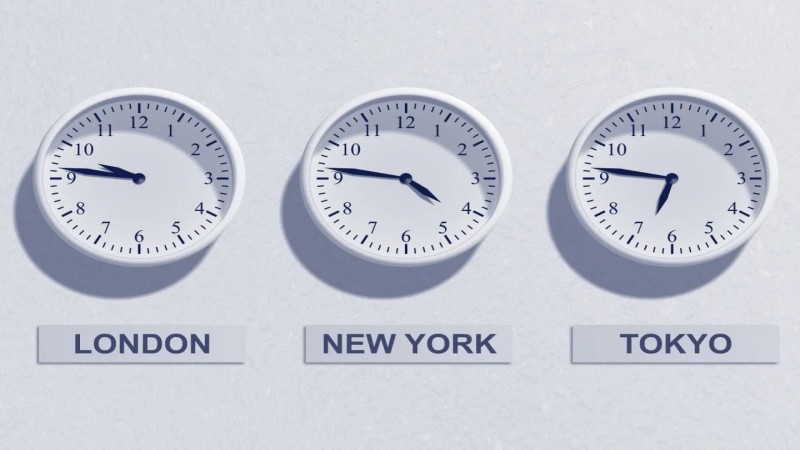
Here is a clear breakdown of the session times in both GMT and BST for 2025. This table will be your go-to reference for planning your trades.
| Session | Major City | GMT (Winter) | BST (Summer) | Key Currencies |
|---|---|---|---|---|
| Pacific | Sydney | 10:00 PM – 7:00 AM | 11:00 PM – 8:00 AM | AUD, NZD |
| Asian | Tokyo | 12:00 AM – 9:00 AM | 1:00 AM – 10:00 AM | JPY, SGD |
| European | London | 8:00 AM – 5:00 PM | 7:00 AM – 4:00 PM | GBP, EUR, CHF |
| North American | New York | 1:00 PM – 10:00 PM | 12:00 PM – 9:00 PM | USD, CAD |
📈 Mastering the Overlaps: Where the Real Action Happens
The most lucrative trading opportunities often occur when two sessions overlap. During these periods, market participation is at its highest, leading to increased liquidity and lower spreads. This means you can get in and out of trades more efficiently and at a better price.
The London-New York Overlap: The Most Volatile Period
(1:00 PM to 5:00 PM GMT)
This is the undisputed main event of the trading day. With both the UK and US markets fully operational, trading volume skyrockets. This four-hour window is arguably the best time to trade forex. The highest levels of liquidity are seen here, and major news from both economies can trigger significant price swings. Pairs like EUR/USD, GBP/USD, and USD/CHF are particularly volatile and offer numerous trading opportunities. Check out Ultima Markets Reviews for user insights.
The Sydney-Tokyo Overlap
(12:00 AM to 7:00 AM GMT)
While less volatile than the London/New York overlap, this period still presents opportunities, particularly for traders focused on APAC (Asia-Pacific) currency pairs. Liquidity is decent, and it can be a good time to trade pairs like AUD/JPY and NZD/JPY.
How to Choose the Best Trading Session for Your Strategy
- For Scalpers and Day Traders: The high volatility and liquidity of the London-New York overlap are ideal. Quick entries and exits are possible with minimal slippage.
- For Trend Traders: The opening hours of the London session often establish the day’s trend. Getting in early can allow you to ride a move for several hours.
- For Part-Time Traders: If you have a day job, the late New York session or the early Asian session might fit your schedule better. While potentially quieter, consistent patterns can still be identified and traded.
😴 Weekends and Holidays: Does the Forex Market Ever Sleep?
While the market operates 24/5, understanding forex market open on weekends is crucial for risk management.
The Weekend Close: Why Trading Halts on Saturday and Sunday
The forex market closes on weekends primarily because the major banks and financial institutions that provide the bulk of its liquidity are closed. While some brokers may offer weekend trading on certain pairs (often tied to Middle Eastern markets which have a Sunday-Thursday work week), the liquidity is extremely low. This results in:
- Wider Spreads: The cost of trading increases significantly.
- Higher Volatility & ‘Gaps’: When the market re-opens on Sunday night, the price can ‘gap’ up or down from its Friday closing price to reflect news or events that occurred over the weekend. This can be extremely risky if you are holding positions.
For most retail traders, it is wise to be flat (holding no open positions) over the weekend.
Navigating Bank Holidays in 2025
Just because the market is open doesn’t mean it’s a good time to trade. A bank holiday in a major financial centre can drain liquidity and lead to unpredictable, choppy market conditions. For example:
- US Bank Holiday (e.g., Thanksgiving): Liquidity will be very thin during the New York session, even if European markets are open.
- UK Bank Holiday (e.g., Boxing Day): The London session will be extremely quiet.
- Japanese Bank Holiday (e.g., Golden Week): Expect reduced activity on JPY pairs.
Always consult an economic calendar to be aware of upcoming bank holidays and plan your trading activity accordingly.
Conclusion: Timing is Your Strategic Advantage
So, what time does the forex market open? It opens on Sunday evening and closes on Friday night. But the professional trader knows the real answer is far more nuanced. It’s about knowing when the opportunity opens.
By aligning your trading with the rhythms of the global sessions—targeting the high-liquidity overlaps and avoiding the treacherous low-liquidity periods of weekends and holidays—you move beyond simply participating in the market. You start to anticipate its moves, understand its personality, and use time as a strategic tool rather than a simple backdrop. Treat the forex clock not as a schedule, but as a map to where the action is. Your trading account will thank you for it.

🤔 FAQ:
1. What time does the forex market open on Sunday in the UK?
The forex market opens for UK traders on Sunday at approximately 10:00 PM during GMT (winter) and 11:00 PM during BST (summer). This corresponds to the Monday morning start of the Sydney session.
2. Is it possible to trade forex 24/7?
No. The forex market is open 24 hours a day, but only five days a week (24/5). It closes for retail traders from late Friday night until Sunday evening. While some platforms may offer limited weekend trading, it is generally not recommended due to low liquidity and high risk.
3. Which forex session is the most volatile?
The London session is typically the most volatile on its own. However, the most volatile period of the entire trading day is the overlap between the London and New York sessions, roughly from 1:00 PM to 5:00 PM GMT. The combination of the world’s two largest financial centres being active at once creates maximum trading volume and price movement.
4. How do I know which trading session I am in?
The easiest way is to use a Forex Market Hours tool or a ‘session clock’ which can be found online or as an indicator on many trading platforms. These tools visually display which sessions are currently open, which are closed, and when the overlaps occur, all adjusted to your local UK time.
*This article represents the author’s personal views only and is for reference purposes. It does not constitute any professional advice.*