

Stepping into the cryptocurrency world often feels like wandering into unfamiliar territory. Words such as Bitcoin, blockchain, NFTs, and decentralisation appear everywhere, yet most newcomers struggle to piece everything together. If you’ve felt lost, you’re in good company. The hype is massive, but the foundational knowledge isn’t always clear.
This guide aims to simplify the core cryptocurrency concepts that every beginner needs. By the end, you’ll understand the essential principles behind digital assets and feel far more confident navigating this rapidly evolving space.
What Cryptocurrency Really Is
Before exploring more advanced ideas, it’s important to clarify what cryptocurrency fundamentally means.
A Beginner-Friendly Explanation
Cryptocurrency is essentially digital money—currency that lives entirely online. Unlike traditional cash stored in banks, cryptocurrencies rely on cryptography to secure transactions and operate independently of central authorities.
This decentralised design is what sets cryptocurrencies apart from conventional financial systems and forms the philosophical backbone of the crypto movement.
How Cryptocurrency Functions
Cryptocurrencies run on blockchain technology, which you can picture as a global, tamper-resistant logbook shared across a network of computers. Each record—called a block—stores verified transactions. Once added, blocks are locked in place and linked to the previous ones, making the entire structure secure and nearly impossible to alter.
Why It’s Called “Crypto”
The “crypto” in cryptocurrency refers to cryptographic techniques that ensure:
- Security: Only rightful owners can authorise transactions.
- Supply Control: New coins cannot be forged or created arbitrarily.
- Verification: Valid transactions are permanently recorded on the blockchain.
Cryptography is the basis for trust in a system where no single authority is in charge.

The 5 Essential Cryptocurrency Concepts Every Newcomer Must Learn
Understanding these five core ideas will dramatically accelerate your learning journey.
1. Blockchain Technology
The blockchain acts as a digital chain of sealed blocks that contain transaction information. Once a block is filled, it is cryptographically linked to the previous one.
Key features include:
- Distributed structure: Stored across a global network.
- Transparency: Anyone can view transaction histories.
- Immutability: Records cannot be easily changed or erased.
Imagine a shared digital notebook where every page becomes uneditable once completed—that’s blockchain in simple terms.
2. Decentralisation
Decentralisation eliminates the need for traditional intermediaries such as banks or payment processors. Instead, users collectively maintain and verify the network.
This model removes single points of failure and makes the system resistant to censorship or control by any one party.
3. Public & Private Keys
To interact with cryptocurrencies, you use a pair of digital keys:
- Public key: Comparable to a bank account number; safe to share with others.
- Private key: Similar to a password; must never be shared.
Your private key grants full access to your assets—protect it at all costs.
4. Cryptocurrency Wallets
Wallets don’t store coins; they store your keys. They serve as your gateway to the blockchain:
- Hot wallets: Apps or software connected to the internet—convenient but less secure.
- Cold wallets: Hardware devices kept offline—ideal for long-term or large-value storage.
5. Mining & Staking
These are the mechanisms that keep blockchains secure:
- Mining (Proof-of-Work): Computers solve complex problems to validate transactions, used by Bitcoin.
- Staking (Proof-of-Stake): Users lock their coins as collateral to help secure the network, used by Ethereum and many modern blockchains.
Staking is significantly more energy-efficient than mining and has become the preferred model for newer projects.

Different Types of Cryptocurrencies Explained
As crypto has matured, various categories have emerged.
Bitcoin (BTC): The Pioneer
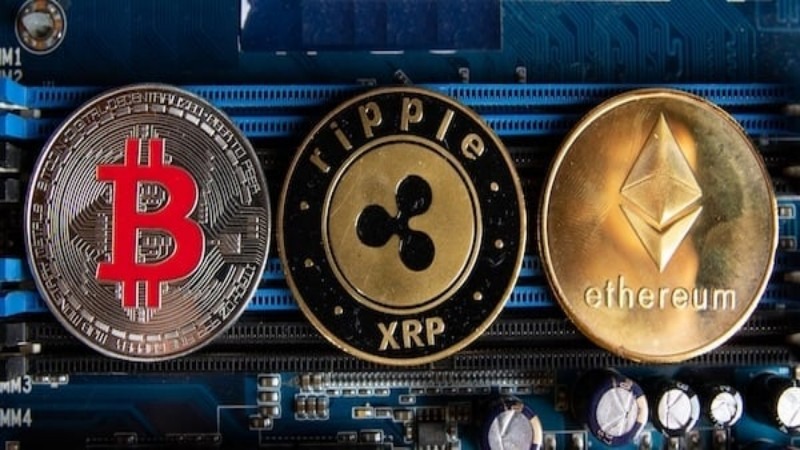
Bitcoin, introduced by the mysterious Satoshi Nakamoto in 2009, was designed as a peer-to-peer digital currency. With a fixed supply of 21 million coins, many now treat it as digital gold—a hedge against inflation and a long-term store of value.
Ethereum (ETH): The Smart Contract Powerhouse
Ethereum takes blockchain a step further by enabling smart contracts—self-executing programs that run automatically. This technology powers decentralised finance (DeFi), NFT marketplaces, blockchain games, and countless decentralised applications.
Ethereum’s native token, ETH, is required to pay for network transactions.
Altcoins, Stablecoins & NFTs
Beyond Bitcoin and Ethereum, thousands of digital assets exist:
- Altcoins: Any coin other than Bitcoin—often offering faster speeds, unique features, or improved scalability (e.g., Solana, Cardano, Ripple).
- Stablecoins: Cryptocurrencies pegged to stable assets to minimise volatility (e.g., USDT, USDC).
- NFTs: Unique one-of-a-kind digital items representing ownership of art, music, collectibles, and more.
How to Start: Understanding the Broader Crypto Ecosystem
After mastering the fundamentals, the next step is learning how to participate in the ecosystem.
Understanding Fiat On-Ramps & Off-Ramps
To buy crypto using real-world money, you need an on-ramp—a service that converts fiat currencies like USD, GBP, or EUR into digital assets. When you want to turn your crypto back into cash, you use an off-ramp.
A reliable and transparent on/off-ramp process is crucial. Many users look for platforms that offer clear policies on deposits and withdrawals to ensure smooth transactions and easy access to funds.
The Role of Cryptocurrency Exchanges
Crypto exchanges function similarly to online brokerages, allowing you to buy, sell, and trade digital assets. When choosing a platform, it’s essential to consider:
- Security
- Fee structure
- Asset variety
- User experience
Many traders also seek platforms with strong reputations for safeguarding client funds. You can explore more about fund protection practices through resources like Ultima Markets fund safety.
If you prefer trading crypto price movements rather than buying the underlying asset, brokers like Ultima Markets offer cryptocurrency CFDs. These let you speculate on price fluctuations without holding actual coins. Traders often use advanced tools such as Ultima Markets MT5 for greater charting precision and flexible order execution.
Before choosing any service, it’s wise to review user feedback and platform performance through resources like Ultima Markets Reviews.

Conclusion
Cryptocurrency is reshaping how people think about money, trust, and financial systems. Although the technology can appear complex, it is built on a handful of core cryptocurrency concepts—blockchain, decentralisation, cryptographic security, and consensus mechanisms.
Understanding these principles allows you to step beyond the noise and make informed decisions, whether you’re investing, exploring new technologies, or simply expanding your financial literacy.
As you continue learning, stay curious but cautious. Crypto can unlock tremendous opportunities, but it also comes with risks. A solid education is your greatest asset in this new digital frontier.
FAQ
Q:What is the most basic idea behind cryptocurrency?
At its core, cryptocurrency is a form of digital money operating on a decentralised blockchain network, allowing secure, peer-to-peer transfers without banks or governments controlling the system.
Q:What are the three main types of cryptocurrencies?
The primary categories are:
- Bitcoin — the original and largest cryptocurrency.
- Altcoins — all non-Bitcoin coins, such as Ethereum or Solana.
- Stablecoins — tokens tied to stable assets like the US dollar.
Q:How should beginners start learning crypto?
Start by understanding major concepts such as wallets, blockchains, private keys, and decentralisation. From there, study key projects like Bitcoin and Ethereum and follow trusted educational sources.
Q:Is cryptocurrency a good investment?
Crypto carries significant volatility and risk. While potential returns can be high, losses can be equally severe. Always conduct your own research and invest only what you can afford to lose.
Q:What is the biggest risk for new crypto users?
Security and volatility. If you lose your private keys, your funds cannot be recovered. And because prices can swing sharply, beginners should tread carefully and focus on learning before investing heavily.
