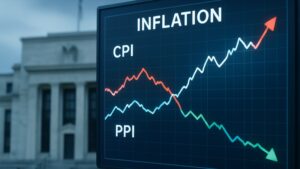
CPI vs PPI for Traders matters because these two inflation reports often shape the biggest market moves of the month. For most traders, CPI usually has the stronger immediate impact on the US dollar, gold, and stock indices, while PPI is more useful as an early signal of upstream price pressure. The real edge in CPI vs PPI for Traders comes from knowing not just what the data says, but how markets reprice rate expectations after each release.
CPI vs PPI for Traders: The Quick Answer for a Trading Edge
When it comes to CPI vs PPI for Traders, CPI is usually the stronger market-moving report. It measures inflation at the consumer level, making it more important for interest-rate expectations, currency moves, bond yields, and index volatility. That is why CPI vs PPI for Traders often leads to one clear conclusion: CPI matters more for short-term trading decisions.
PPI still matters in the broader CPI vs PPI for Traders framework because it tracks price changes at the producer level and can signal pipeline inflation before it reaches consumers. Even so, the pass-through from producer prices to consumer prices is not always immediate or complete. Companies may absorb part of those costs, which is why PPI usually has less direct market impact than CPI. For event-driven traders, CPI tends to be the dominant release. For medium-term inflation analysis, PPI adds useful context.
What CPI Measures and Why It Dominates Market Reactions
The Consumer Price Index is the most widely recognised measure of inflation, directly influencing monetary policy and, consequently, financial market valuations. Its dominance stems from its direct relevance to the economic well-being of consumers and its central role in policy mandates.
Understanding Consumer Prices and Monetary Policy Sensitivity
CPI reflects the weighted average cost of a basket of consumer goods and services that mirrors household spending patterns. That makes it highly relevant in the CPI vs PPI for Traders discussion because it captures inflation where it affects consumers most directly. Markets pay close attention to this data because inflation at the consumer level has a stronger influence on policy expectations and overall market sentiment.
For traders comparing consumer inflation and producer inflation, the key difference is market sensitivity. CPI surprises tend to create larger and faster reactions because they feed directly into expectations for rates, yields, and risk appetite. That is the main reason CPI vs PPI for Traders usually favours CPI as the more important report for short-term price action, even though PPI remains valuable as a leading signal of cost pressure.
How CPI Directly Influences Interest Rate Expectations
Financial markets operate on expectations. Before a CPI release, economists and analysts publish forecasts, and asset prices reflect this consensus. The trading opportunity arises when the actual data release differs from these forecasts. For instance, a headline CPI figure coming in at 0.5% month-over-month when 0.3% was expected is a significant inflationary surprise. Traders will immediately recalibrate the probability of future rate hikes, leading to:
- A stronger domestic currency (e.g., higher USD) as higher rates attract foreign capital.
- Higher bond yields (lower bond prices) to compensate for inflation and anticipated policy tightening.
- Potential weakness in equity indices as higher borrowing costs can hinder corporate growth.
This immediate cause-and-effect mechanism is why CPI often generates more pronounced volatility than PPI.
What PPI Measures and Why It’s a Crucial Forward-Looking Indicator
The Producer Price Index offers a view of inflation from the perspective of producers and manufacturers, making it a key tool for gauging price pressures earlier in the supply chain. While its market impact is often more subdued than CPI’s, its predictive value should not be underestimated.
Tracking Producer Prices and Upstream Inflationary Pressures
PPI measures the average change over time in the selling prices received by domestic producers for their output. It is often broken down by industry and commodity, providing granular detail on where costs are rising.
For example, a sharp increase in the PPI for raw materials or intermediate goods indicates that businesses are paying more for their inputs. This information is vital for analysts and traders trying to forecast the future path of consumer inflation. If producers consistently face higher costs, they are more likely to pass these on to consumers, which would eventually be reflected in the CPI data.
Why PPI Can Lead CPI, But Not Always
The theory that PPI is a leading indicator for CPI is logical but not infallible. There is often a time lag, typically several months, between a rise in producer prices and a subsequent rise in consumer prices. However, several factors can weaken this correlation:
- Margin Compression: In a competitive market, companies might absorb higher input costs by accepting lower profit margins rather than raising prices for consumers.
- Productivity Gains: Businesses may offset rising input costs through efficiency improvements or technological advancements.
- Substitution: Producers might switch to cheaper alternative inputs, mitigating the cost pressure.
Because of these variables, traders must view PPI as a valuable clue, not a guarantee, in the complex puzzle of the CPI vs PPI for traders analysis.
How Different Asset Classes React to CPI and PPI Releases
The release of inflation data sends ripples across all major asset classes, though the intensity and direction of the moves can vary. A higher-than-expected inflation reading generally signals a more aggressive monetary policy response, which is the primary driver of these price changes.
| Asset Class | Typical Reaction to Higher-Than-Expected Inflation (CPI/PPI) | Primary Rationale |
| The US Dollar (DXY) and Forex Majors | Strengthens | Markets price in higher probability of interest rate hikes, increasing the appeal of holding the currency. |
| Treasury Yields (e.g., US 10-Year) | Rise | Bond investors demand higher returns to compensate for eroding purchasing power and anticipate policy tightening. Bond prices fall as yields rise. |
| Gold (XAU/USD) | Mixed / Often Down | The reaction is complex. Higher inflation supports gold’s role as a hedge, but the resulting stronger dollar and higher real yields increase the opportunity cost of holding the non-yielding metal, often leading to a net-negative impact. |
| Equity Indices (S&P 500, Nasdaq) | Often Weaken | Higher inflation can mean increased input costs for companies and lower consumer purchasing power. More importantly, higher interest rates increase borrowing costs and discount future earnings more heavily, reducing stock valuations. |
A Trader’s Checklist for Analysing Inflation Reports
Professional traders look beyond the single headline number. A disciplined approach to analysing the CPI vs PPI for traders data involves dissecting the report’s components to understand the true underlying inflation trend.
Forecast vs. Actual: The Expectation Game
For short-term traders, the real opportunity in CPI vs PPI for Traders comes from the gap between the forecast and the actual reading. Markets do not react to inflation data in isolation. They react to whether the number is hotter or cooler than expected. Even a high CPI print may trigger only a limited move if traders had already priced it in. A clear upside or downside surprise is what usually creates the strongest volatility across forex, gold, bond yields, and equity indices.
This is why any practical CPI and PPI trading strategy starts with the consensus estimate. Traders comparing consumer inflation vs producer inflation should always know what the market expects before the release. In the CPI vs PPI for Traders framework, the surprise element often matters more than the headline number itself.
Headline vs. Core: Filtering Out Volatility
A strong CPI vs PPI for Traders analysis should also separate headline from core inflation. Headline data can drive the first reaction, but core inflation often gives the cleaner view of underlying price pressure. For traders, that makes core data more useful when judging whether inflation is temporary or persistent.
Month-over-Month (MoM) vs. Year-over-Year (YoY): Gauging Momentum
In CPI vs PPI for Traders, year-on-year shows the broader trend, while month-on-month shows short-term momentum. YoY explains the bigger inflation picture, but MoM often helps traders spot turning points earlier. Using both gives a clearer read on inflation direction.
When CPI Matters More and When PPI Matters More
In CPI vs PPI for Traders, CPI usually matters more when markets are focused on consumer inflation, rate expectations, and short-term moves in the US dollar, gold, and stock indices. In demand-driven conditions, CPI is often the inflation report that traders watch first because it gives the clearest signal on final-stage price pressure.
PPI becomes more important when producer costs rise quickly or supply-side pressure starts building. In this part of the CPI vs PPI for Traders discussion, producer inflation can act as an early warning signal for future price pressure. For traders, the key is not choosing one report in isolation, but knowing which inflation indicator matters more in the current market environment.
Common and Costly Mistakes Traders Make with Inflation Data
Trading economic data is fraught with challenges, and misinterpreting inflation reports can lead to significant losses. Avoiding common pitfalls is as important as correctly analysing the data. A key aspect of the CPI vs PPI for traders discussion is avoiding oversimplification.
Mistake 1: Treating PPI as a Perfect CPI Predictor
The most common error is assuming a linear, one-to-one relationship where a high PPI reading will inevitably lead to a high CPI reading. As discussed, factors like corporate profit margins, global competition, and productivity can sever or delay this link. Blindly taking a long position in the USD after a high PPI release, expecting a high CPI to follow, is a speculative and unreliable strategy. The smarter approach is to use PPI to build a directional bias but wait for confirmation from CPI or other data points.
Mistake 2: Only Watching the Data, Not the Market’s Reaction
The data itself is only half the story; the market’s reaction is the other, more important half. Sometimes, the market’s response can be counter-intuitive. For example, an in-line inflation report might still cause a major rally if the market was subtly positioned for a downside surprise.
The most valuable information comes from observing the price action in key assets like the 2-year Treasury yield and the US Dollar Index (DXY) in the minutes following the release. Their reaction tells you how the most influential market participants are interpreting the data’s policy implications.
Mistake 3: Overlooking Revisions to Previous Reports
Buried within every inflation report are potential revisions to the previous month’s data. These are often overlooked by novice traders who are fixated on the new headline number. A significant downward revision to the prior month’s data can completely negate the impact of a slightly higher-than-expected current reading. Always check for revisions, as they can alter the underlying inflation trend and cause the market’s initial reaction to reverse.
Final Takeaway for Traders
The resolution to the CPI vs PPI for traders debate is not to choose one over the other, but to use them as a complementary pair of analytical tools. Your trading strategy should dictate which report you prioritise.
- For short-term, event-driven traders: The CPI release is the main event. Your focus should be on the deviation of the core MoM figure from the consensus forecast, as this will generate the most immediate and tradeable volatility.
- For medium-term swing and position traders: The trend in PPI is a crucial piece of forward-looking intelligence. Analysing the pipeline of inflation from producer to consumer can help you position for broader trends in monetary policy and asset class performance over weeks or months.
Ultimately, the most successful traders integrate both data sets into a holistic view of the inflationary landscape. By understanding what each report measures, how markets react, and the common analytical mistakes to avoid, you can harness the power of inflation data to make more informed and strategic trading decisions in 2026 and beyond.
Frequently Asked Questions (FAQ)
Which is more important for a trader, CPI or PPI?
CPI is usually more important for traders. It tends to drive stronger short-term moves because it has a more direct impact on rate expectations, the US dollar, gold, and stock indices. PPI still matters, but it is usually more useful as an early signal of producer-side inflation pressure.
How soon after a CPI or PPI release do markets typically react?
Markets usually react within seconds of the release. The first move is often driven by algorithmic trading, while the next wave comes as traders digest the headline, core reading, and the gap versus forecasts. The biggest volatility often appears in the first few minutes.
Does a high PPI reading automatically mean a high CPI will follow?
No, a high PPI does not automatically lead to a high CPI. Producer costs do not always pass through fully to consumers because companies may absorb part of the pressure through lower margins or pricing adjustments. That is why PPI is useful, but not a guaranteed predictor of CPI.
How does core inflation differ from headline inflation, and which should traders watch?
Headline inflation includes all items, while core inflation excludes food and energy. Traders should watch both, but core inflation often carries more weight for the broader market trend because it gives a cleaner view of underlying price pressure. Headline data may drive the first reaction, but core data often shapes the follow-through.